
Why is a CRM worthwhile?
A CRM helps companies steer customer relationships, generate sales opportunities and measure and increase customer satisfaction. The result is more revenue or higher profitability per customer. ERP and CRM are the key applications for digitalising business processes, with the aim of automating as much as possible.
One thing is clear: introducing a CRM involves more than choosing software. Processes need to be analysed and adapted, and choosing the right architecture is decisive for meeting high expectations.
Which options are there?
Companies with an ERP have two options:
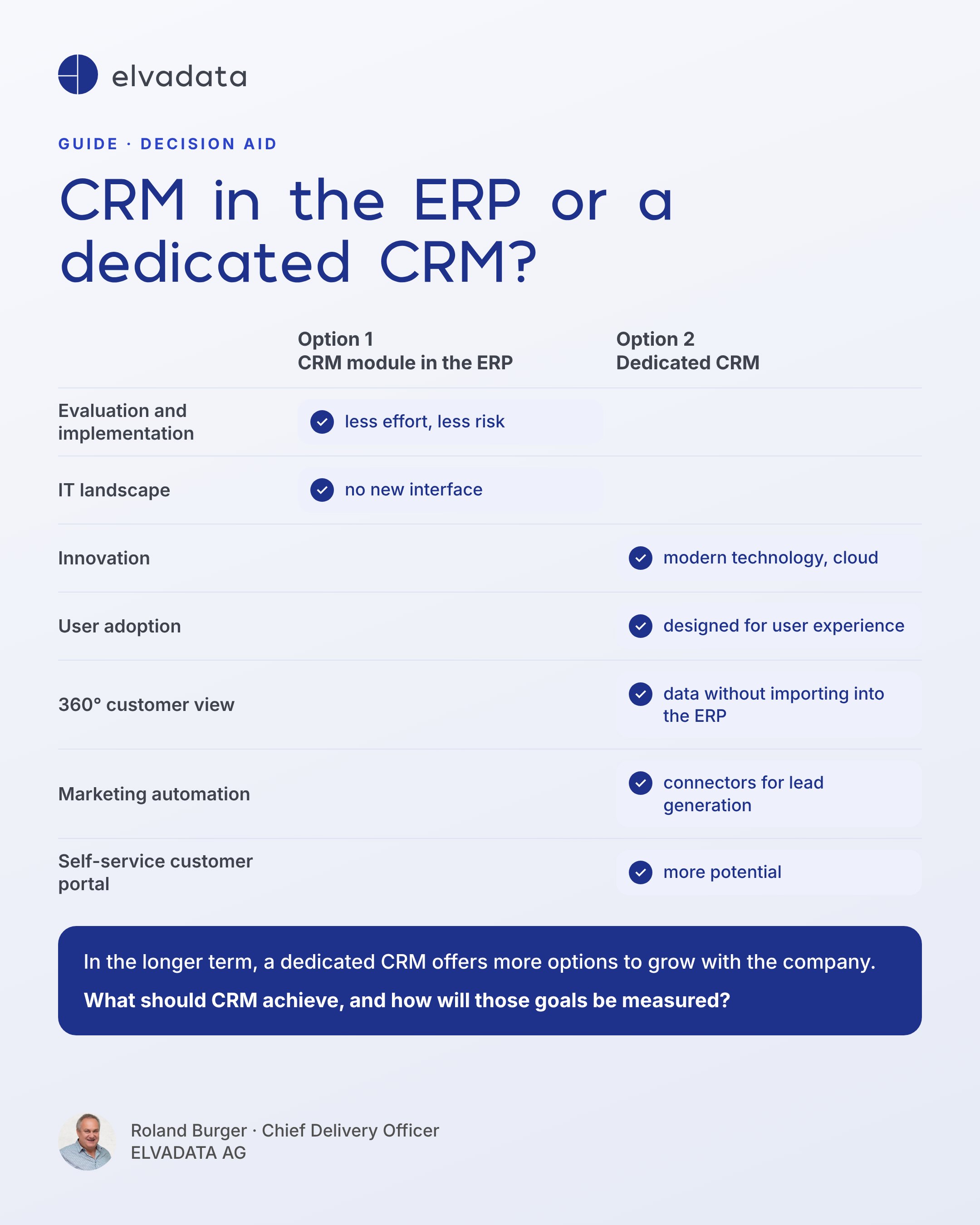
- Option 1, CRM module in the ERP: the CRM module of the existing ERP is used, which most ERP software vendors offer.
- Option 2, dedicated CRM system: a separate CRM system is evaluated and introduced, independently of the ERP.
The options have different consequences, advantages, disadvantages and risks. They also differ in their opportunities, that is, their potential benefits.
How much effort do evaluation and implementation take?
If the existing ERP offers a CRM module, option 1 is the most obvious solution: the customer knows the vendor, and the vendor is already familiar with the situation. With a separate CRM system, the company has to look more closely at what it wants to achieve. A specification is drawn up, potential vendors are selected and contacted, followed by evaluation and selection.
Evaluation and procurement take considerably more effort in option 2. The same applies to the implementation project: in option 1 it is more manageable and exposed to fewer risks.
What does the choice mean for the IT landscape and IT organisation?
In option 1 the system landscape stays unchanged, because the CRM is part of the existing ERP application. A separate CRM system adds at least one new interface to the ERP, which has to be programmed and maintained.
The CRM is the leading system for customer and contact data. Option 1 already fully meets this requirement; in option 2, intelligent synchronisation between ERP and CRM ensures it. Option 1 has the advantage that only the customer data needed for the ERP processes is kept in the ERP. A dedicated CRM, on the other hand, can be extended freely, technically and organisationally independent of the ERP. This contributes to the stability and security of the ERP while meeting growing CRM requirements.
In option 1 the IT organisation takes on few new tasks. In option 2 the IT department has to take over administration of the CRM system, including the interfaces.
Which option is more innovative?
CRM modules in the ERP are developed within the technical constraints of the ERP technology, which is often more than 20 years old. Their capacity for innovation is therefore limited, and they use technologies whose end of life has long been reached. In addition, the ERP vendor’s development capacity has to cover the entire ERP suite and is not explicitly available for the CRM.
CRM systems, by contrast, are considerably more modern and built with new technologies. They are also available from the cloud, and cloud technology is undisputedly the driver of innovation in digital transformation.
Which option do users accept better?
With option 1, users are already familiar with the ERP system and can quickly use the newly available CRM functions. However, ERP systems are de facto not very user-friendly, and this also applies to the integrated CRM. CRM systems are built with new technologies, and user experience was a focus of their development from the start. This has a positive effect on acceptance: target groups in sales, field sales and marketing often accept CRM solutions better than a CRM module in the ERP.
What does a 360° customer view require?
The 360° customer view is a central task of a CRM. CRM systems are built so that this view can be comprehensive: all company data related to the customer has to flow in, including all Access and Excel files kept in the shadows. An integration architecture can connect data from all relevant internal and external systems with customers and contacts to create the broadest possible information base for sales opportunities. Option 1 has the disadvantage here that this data has to be imported into the ERP, which in turn can affect the stability and security of the ERP system.
What role does marketing automation play?
In campaigns, information and offers are distributed to defined target groups via the most widely used channels. In addition, further tools for lead generation (B2B, B2C) provide valuable information on how a campaign is received by the target group. CRM systems have connectors to lead generation tools or already provide this feature. Experience shows that companies grow in exactly this area after introducing a CRM. It is therefore important to choose a CRM solution that allows marketing automation to be expanded. Here option 2 has the advantage over option 1.
Why a self-service customer portal?
CRM data has to be up to date. A customer portal with self-service features can partly delegate this task to customers. But customers only use a portal if they see added value compared with other channels. To achieve this, customer portals need to offer at least service and knowledge features, so that customers prefer this channel to e-mail and phone. A CRM solution should support development in this area as well as possible, and more is expected here from vendors of CRM systems. Option 2 therefore has more potential here than option 1.
Which option is the right one?
A dedicated CRM system is the more demanding option. In the longer term, however, it offers more options to unlock potential benefits and grow with the company. It is advisable to give CRM the attention it needs and to focus resources on it. Decision-makers should look closely at one question:
What goals should CRM achieve, and how will these goals be measured?
About the author
Roland Burger is Chief Delivery Officer and ERP/CRM consultant at ELVADATA AG. This article first appeared in topsoft Fachmagazin 23-1. Elvadata supports companies with CRM based on Salesforce and ERP with Sage X3, and connects both systems where it makes processes easier.